AEO & GEO
AI Visibility: What Clients Should Know
11 min read

Adam Khaled
Founder, Web25
Adam Khaled
Founder, Web25
Quick answer: AI visibility is how often and how accurately a business gets named when someone asks ChatGPT, Google AI Overviews, Perplexity, or Gemini a question about its category. It’s not one score: a business can perform well on one AI platform and be invisible on another, so tracking it means checking each surface separately, not just checking a single ranking.
AI visibility is whether a business shows up, by name, when someone asks an AI tool a question its content should be able to answer. That matters because a growing share of buyer research now happens inside an AI conversation instead of a traditional results page, so a business invisible there is invisible at the exact moment a buyer is forming an opinion. It’s a broader idea than answer engine optimization (AEO) or generative engine optimization (GEO), which are the specific techniques used to earn that visibility. Web25 covers those techniques in its guides to answer engine optimization and GEO tools and agencies.
Think of it as the scoreboard, with AEO and GEO as the plays that move it. A business can do AEO work on its site and still need to check whether that work is actually translating into real citations across the AI tools its customers use.
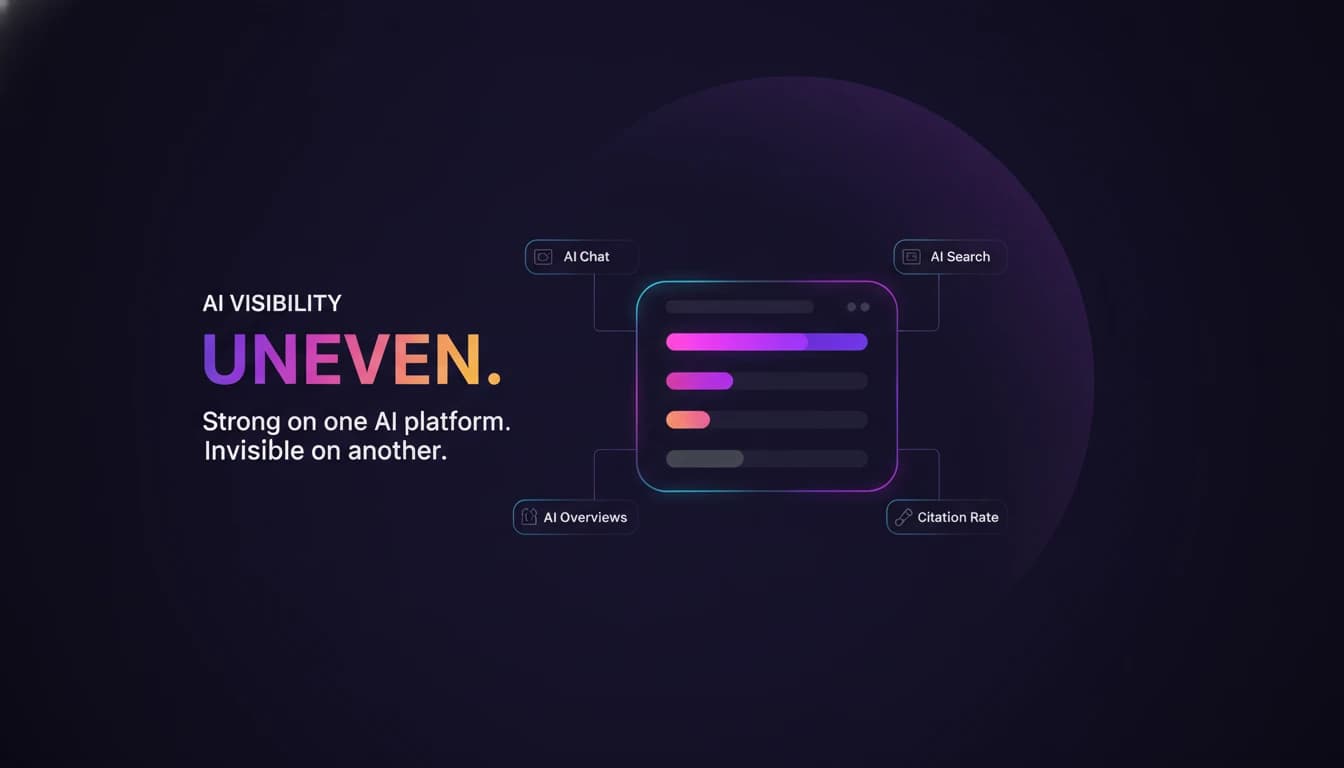
Different AI platforms cite sources differently, so a single “visibility score” from one tool doesn’t tell the whole story. Per Semrush’s 2026 index, ChatGPT averages 15 source citations per response, while Google Gemini averages only about 3. A business that shows up reliably on ChatGPT can still be effectively invisible on Gemini, simply because Gemini cites far fewer sources per answer to begin with.
The same study found the overlap between brands an AI tool mentions and the sources it actually cites can be as low as 30% on some platforms. Getting named is not the same as getting credited as a source, and only the second one reliably drives a click.
| AI surface | How citation behaves | What to check |
|---|---|---|
| ChatGPT | Averages ~15 source citations per response (Semrush, 2026) | Ask a category question, see if you’re named and linked |
| Google Gemini | Averages ~3 source citations per response, far fewer than ChatGPT | Run the same test, expect a smaller citation pool overall |
| Google AI Overviews | Cites sources inline, directly inside regular search results | Search your main keyword and check the AI Overview box |
| Perplexity | Source-link-heavy by design, built around citation | Ask a comparison question in your category |
Start with a direct test before reaching for a paid tool. Ask ChatGPT, Perplexity, and Google (in both regular search and AI Mode) a real question a customer would ask about your category, not your brand name. Ask it two or three different ways, since small wording changes can change which sources an AI tool decides to pull from. Note whether your business gets named, whether it gets cited as a source with a link, or whether it’s missing entirely.
The fixes are the same ones that drive AEO and GEO, applied consistently rather than once: answer-first content structure, FAQ and structured-data schema, and confirming AI crawlers can actually reach your site. Cloudflare’s 2026 default AI-crawler blocking made that last point a live issue for a lot of sites overnight — see Web25’s breakdown of what changed and what to check on your own site.
Original, specific content also matters more here than it does for classic SEO. AI systems favor named facts, real numbers, and clear expert reasoning over generic restated advice, since that’s what makes a page worth citing as a source instead of just paraphrasing. A page that only repeats what ten other pages already say has nothing distinct for an AI system to pull from, even if it’s technically well structured.
A one-time check tells you where you stand today, not whether you’re improving. Free graders like HubSpot’s AI Search Grader give a baseline snapshot. Paid platforms like Profound or Scrunch track citation rate continuously across multiple AI tools at once, which matters given how much it varies by platform. Web25 breaks down the free-versus-paid decision in more detail in its GEO tools and agencies guide. Whichever route you pick, re-check on a fixed schedule rather than once and forgetting about it, since AI models update often enough that last quarter’s result won’t reliably hold.
Web25 is our agency, and AI visibility work is one of the services we run alongside web development and SEO/AEO/GEO.
Web25 checks this across platforms before recommending fixes, then applies the same AEO and GEO fundamentals consistently: content restructuring, schema markup, AI-crawler access, and ongoing citation tracking. See the SEO, GEO & AEO service page for the full scope, or book a discovery call to talk through a specific site.
AEO (answer engine optimization) is the technique: structuring content so AI tools can quote it. AI visibility is the outcome: whether that technique is actually working, measured by how often a business gets named or cited across ChatGPT, Gemini, Perplexity, and Google AI Overviews.
No. Per Semrush’s 2026 index, ChatGPT cites roughly 15 sources per response on average, versus about 3 on Gemini. A business can perform well on one platform and be effectively invisible on another, so checking only one tool gives an incomplete picture.
Ask ChatGPT, Perplexity, and Google AI Mode a real customer question about your category, not your brand name, and note whether you’re named, cited with a link, or missing entirely. A free grader like HubSpot’s AI Search Grader gives a quick baseline across tools.
Not directly, but the underlying work overlaps heavily. Answer-first content, clear structure, and schema markup help both classic rankings and AI citation at the same time, since both reward pages that are easy to parse and clearly answer a specific question.
A monthly check is reasonable for most small businesses, since AI answers change as models update and content gets re-crawled. Sites actively working on AEO or running a real content program benefit from continuous tracking through a paid platform instead of manual spot checks.
Yes. AI tools pull from whichever page answers a question clearly and specifically, not from brand size alone. A well-structured local business page can get cited for a local or category question just as easily as a national brand’s page can.
Rewrite one high-value page so it answers its main question in the first two sentences, then add FAQ schema matching the visible questions. That single change is usually the highest-leverage fix available before considering a broader AEO or GEO engagement.
Ask ChatGPT or Perplexity a real question about your category and see whether you’re named. If you’re not, or you’re only showing up on one platform, start with Web25’s guide to answer engine optimization, or book a discovery call to talk through your own site.
Written by Adam Khaled, Founder, Web25. Last updated September 2026.
Apple’s rebuilt Siri now runs on Google’s Gemini. Here’s what that actually means for AEO, and why it matters more than the Siri headline suggests.
Cloudflare now blocks AI training and agent crawlers by default on ad-carrying pages. Here’s what changed today, and what to check on your own site.
What full-service website management actually includes, what it costs versus a maintenance-only plan, and how to tell whether your business needs it.