AEO & GEO
GEO Agency: What to Look For and What It Costs
13 min read

Adam Khaled
Founder, Web25
Adam Khaled
Founder, Web25
Quick answer: A GEO agency helps your business get named and cited inside AI answers from tools like ChatGPT, Perplexity, and Google’s AI features. Vendor-published prices run from about $500 a month for a freelancer to $10,000 or more for enterprise work. Pick one that shows its process, reports mentions and citations, and never guarantees a result.
More buyers now ask ChatGPT and Google’s AI features for a recommendation before they ever open a search result. Agencies have noticed, and many have added GEO to their service list overnight. That makes the buying decision harder, because the work is new, prices vary widely, and most claims are hard to check. This guide gives you a plain way to judge one.
A GEO agency works to get your business named, described accurately, and linked inside answers written by AI tools. GEO stands for generative engine optimization. It builds on normal SEO and adds work aimed at being easy for an AI to quote. Web25’s guide to GEO vs SEO explains how the two fit together.
The work usually falls into four parts. First comes an audit of how your business appears in AI answers today. Next, pages are rewritten so each one answers its main question early and clearly. Then come technical fixes, such as structured data and making sure pages are indexed. Last, the agency tracks mentions and citations so you can see whether anything changed. Web25 covers the tools side in its guide to GEO tools and agencies, so this article focuses on the hiring decision.
Keep one fact in mind while you shop. Google says there are no additional requirements to appear in its AI features beyond being indexed and eligible to show with a snippet. A good GEO agency should not claim a secret method. It should do the basics well, then make your content easier to quote.
No standard rate card exists, so prices vary a lot. The best public figures come from vendors, which means they come with a bias. An April 2026 pricing guide from AY Rank, a GEO provider that also lists its own prices, reports these monthly ranges. It says they are based on research across more than 40 agencies and freelancers.
| Type of provider | Reported monthly range |
|---|---|
| Solo freelancer | $500 to $2,000 |
| Boutique agency | $2,000 to $5,000 |
| Enterprise agency | $10,000 to $30,000 or more |
| Citation tracking software | $100 to $500 |
Read those numbers as a rough guide. They are not verified averages, and Web25 has not tested them. The same guide notes that mid-market retainers often land between $2,000 and $8,000 a month. A small business should expect to sit near the low end, or to pay for a fixed project such as an audit plus rewrites of a few pages.
Four things move a quote. The number of pages to rewrite is the biggest. The size of the prompt list being tracked comes next. Then comes whether the agency also writes new content or only edits what exists. Finally, there is how much technical work your site needs. Ask each agency to price those four items separately so you can compare quotes fairly.
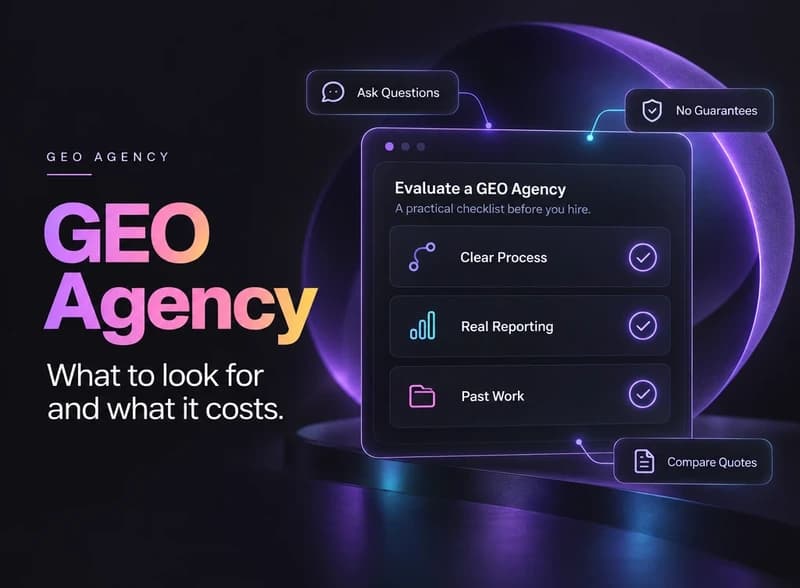
Look for proof of process, not proof of promises. Google’s own guide to hiring an SEO suggests asking for examples of previous work and success stories, asking how success is measured, and checking references with past clients. Those questions work just as well for GEO.
The agency should explain what it will do in plain words and what you will get each month. If the plan is vague, the results will be too.
Ask which prompts they track and how often they run them. AI answers change from run to run, so a single screenshot proves nothing. SparkToro ran the same prompts thousands of times and found the chance of getting the same brand list twice was under one in 100. A serious agency reports a rate across many runs. Web25’s guide to AI search tracking shows what that looks like.
GEO is not only reformatting. The agency should add sourced facts, clear answers, and original detail to your pages. If all it offers is a schema plugin and a new heading style, you are paying for the easy half.
Most red flags come straight from Google’s advice on hiring an SEO. Google warns that no one can guarantee a number one ranking, and that you should be careful with any company that is secretive or will not explain what it plans to do.
Google also advises that if you give an SEO access to Search Console for an audit, you should start with read access only. The same habit is sensible for any new agency working on your site.
Bring a short list. Good answers come fast and in plain language. Weak answers turn into sales talk.
That last question matters. Content and fixes should stay on your site and belong to you if you leave. If the agency cannot say that clearly, ask why.
Put every quote into the same five rows so you can compare them line by line. The rows are the number of pages covered, the number of prompts tracked, who writes the content, what technical work is included, and what you receive each month. A low price that covers three pages and ten prompts is not cheaper than a higher one that covers twelve pages and forty prompts. Ask each provider to fill in the same rows, and treat any blank as a question to chase.
Next, think about a pilot before a long contract. A pilot can be a fixed three-month project on your most valuable pages. Before it starts, agree on a short list of real customer questions and run them yourself, several times, to set a baseline. Write down how often your business is named and whether your page is linked. Run the same list at the end and compare.
That gives you a number that belongs to you, not to the provider. If mentions rose, you have a reason to continue. If they did not, you have a clear record of what was done, and you can ask why before you commit more money. Be fair about what you read, though. AI answers vary, so small changes in a single month mean little. Look for a steady pattern across the months.
Finally, agree on ownership in writing before any work begins. Pages, copy, and technical fixes should sit on your site under your control, and you should keep access to every report. Ask for a short summary at the end of the pilot that lists each change made, so a future provider can pick up where the last one stopped.
Start with what you can do alone. Check that your key pages are indexed, open each one with a direct answer, add named sources and real figures, and run the same 10 to 15 customer questions through AI tools once a month. That costs time, not retainers.
Hire help when the list is bigger than your team can ship. That usually means many pages to rewrite, technical fixes you cannot make, or no one who can write clearly about your field. A small project may be a better first step than a long retainer. You can always extend it if the monthly checks show movement. Web25’s guide to AEO vs GEO covers the terms you will hear in pitches.
Web25 offers GEO and AEO work alongside classic SEO and web development. The approach is the one described above: fix the basics, rewrite priority pages so they are easy to quote, and check mentions monthly. Web25 is also the agency publishing this guide, so weigh that. This article does not state Web25 prices, because they are not published here. See the AEO and GEO service page for what is included.
Vendor-published ranges run from about $500 to $2,000 a month for a freelancer, $2,000 to $5,000 for a boutique agency, and $10,000 or more for enterprise work. There is no standard rate card, so compare what each quote includes, not just the monthly number.
No. Google says no one can guarantee a number one ranking, and AI answers are even less predictable. SparkToro found the chance of getting the same brand list twice was under one in 100. Treat any citation guarantee as a reason to walk away.
You can do the basics yourself: fix indexing, write direct answers, add sourced facts, and check a set of prompts monthly. An agency helps when you lack the time or the writing and technical skills to ship those changes across many pages.
No reliable industry timeline exists, and vendors give different answers. Ask for the expected timeframe in writing, along with how they measure it. A sensible check is a monthly run of the same prompts, so you can see movement over a few months.
Mostly, yes. Many vendors use GEO and AEO interchangeably, and the work overlaps. Web25 uses AEO for winning the direct answer to one question and GEO for being named across AI tools. Judge the agency by its deliverables, not the label.
Mentions and citations across a fixed prompt list, what changed on your pages, and what they plan next. You should also see clicks and sessions from AI tools in Google Analytics. Activity counts like pages published do not show whether anything worked.
Write your list of 10 to 15 customer questions today and run them through ChatGPT and Google’s AI features to see where you stand. Then use the questions above on two or three providers, or book a discovery call to talk through your own site.
Written by Adam Khaled, Founder, Web25. Last updated September 2026.
Content pruning case study: we removed 103 pages from LiveAgent and impressions rose. What we did, what Google says, and what is unproven.
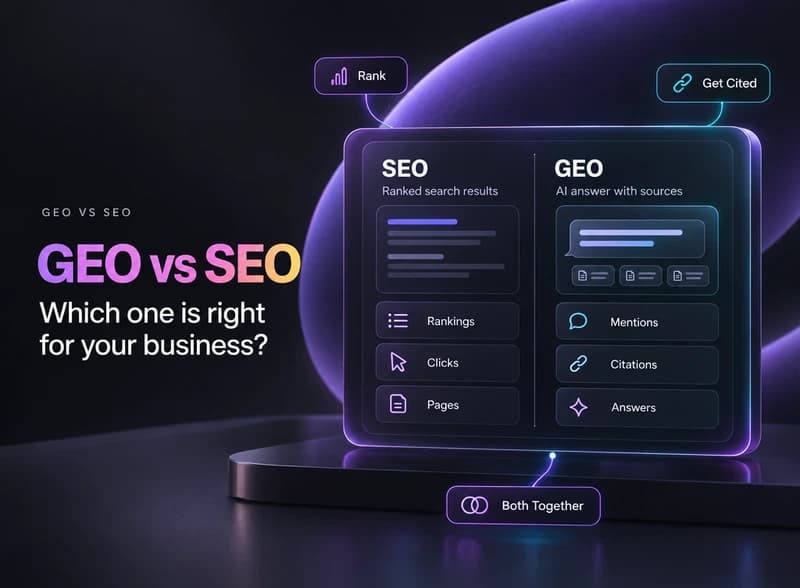
GEO vs SEO explained in plain English: what each one does, where they overlap, and why most small businesses should keep SEO as the base and add GEO.
AI search tracking means checking how often ChatGPT, Google’s AI features, and Perplexity mention or link to your business. Three free methods cover most small sites.