AEO & GEO
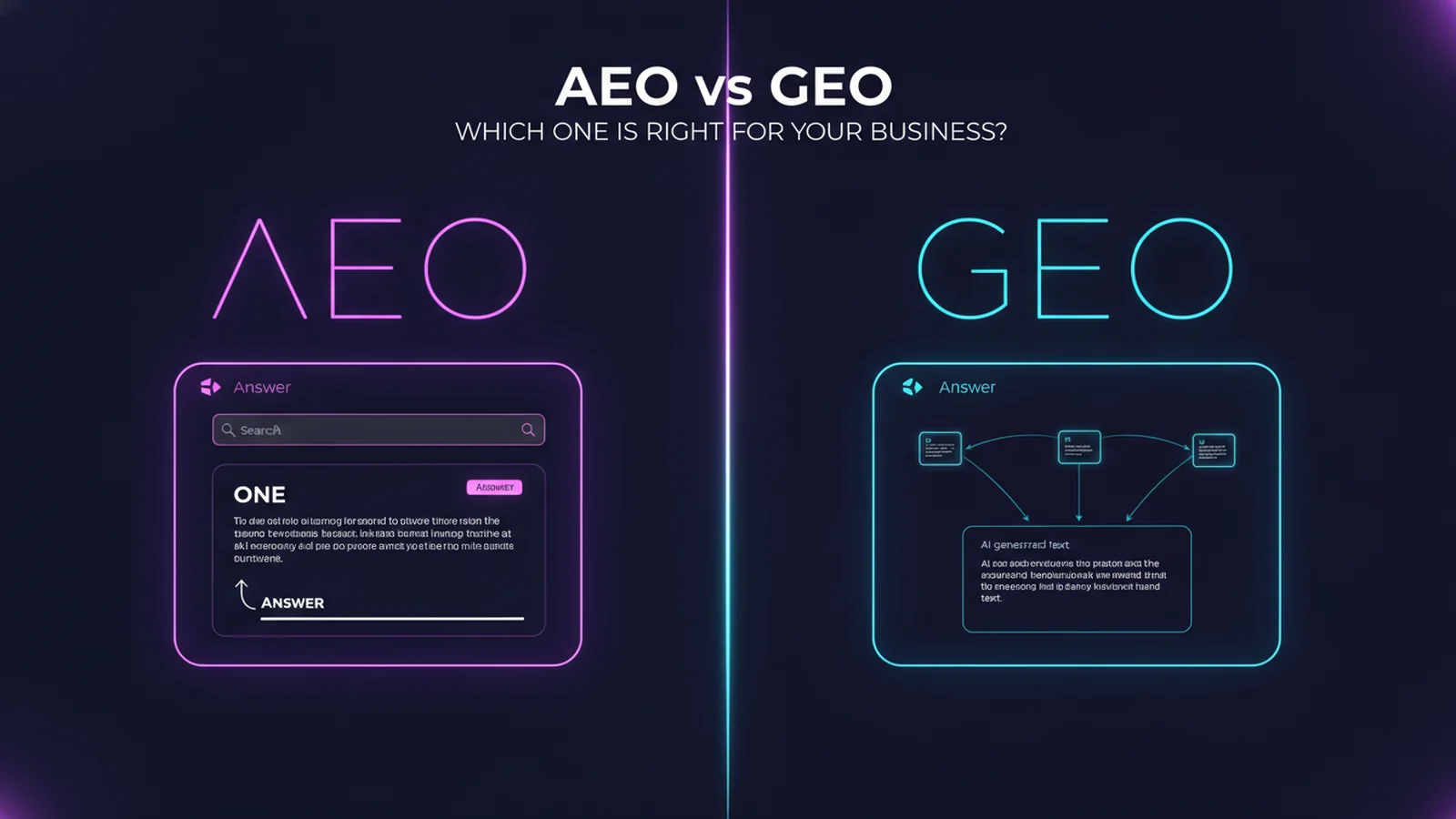
AEO vs GEO: Which One Is Right for Your Business?
14 min read

Adam Khaled
Founder, Web25
Adam Khaled
Founder, Web25
Quick answer: AEO vs GEO comes down to this: the AEO meaning is answer engine optimization, structuring a page so an AI tool like ChatGPT, Google AI Overviews, or Perplexity can lift a direct answer straight from it, the way it once lifted featured snippets. GEO (generative engine optimization) is the broader practice of getting a generative AI system to cite or reference your content anywhere inside a longer synthesized answer, not just quote one line. Most small businesses eventually need both. Which one to prioritize first depends on where your buyers actually search.
AEO stands for answer engine optimization. The AEO meaning is simple: writing and structuring a page so a machine, not just a human reader, can pull out one clean, accurate answer and use it as-is. That’s the same instinct that used to win a Google featured snippet, just extended to AI chat answers, voice assistants, and Google’s AI Overviews.
GEO stands for generative engine optimization. It’s a newer term, and unlike AEO it has a documented origin: researchers Pranjal Aggarwal, Vishvak Murahari, and colleagues at Princeton and Georgia Tech introduced it in a November 2023 paper, later accepted to the KDD 2024 conference, which built a benchmark for measuring how content changes affect visibility inside generative AI answers. Their headline finding: applying GEO techniques boosted a page’s visibility in generative engine responses by up to 40%, though the effect varied by topic (Aggarwal et al., 2023/2024).
In practice, both terms describe writing for AI-driven answers instead of a list of blue links. Web25 covers the fuller AEO definition and how it fits alongside SEO in its plain-English guide to AEO, and the outcome both disciplines are chasing, actually getting named across AI tools, in its guide to AI visibility.
AEO optimizes for one clean, extractable answer. GEO optimizes for being one of several sources an AI model draws from and blends together. The difference sounds small, but it changes what “winning” looks like.
An AEO win looks like this: someone asks “how much does a new roof cost in Ohio,” and an AI assistant reads back a single paragraph from your page, close to word for word. A GEO win looks different: someone asks a broader question, the AI model pulls a fact from your page, a fact from a competitor’s page, and a data point from an industry report, then writes its own paragraph that credits your page as one of three sources. You didn’t get quoted directly, but you got cited, and citation is what drives the click.
| Aspect | AEO priority | GEO priority |
|---|---|---|
| What “winning” looks like | Being the direct answer an AI tool quotes whole | Being one of the cited sources inside a synthesized answer |
| Where it came from | Featured snippets and voice search, extended to AI chat | Academic research on how large language models select sources |
| Content format that wins | A tight, self-contained answer paragraph near the top | Well-sourced claims, data, and quotes an AI model can pull from and attribute |
| Best measured by | Whether your exact wording shows up in an answer | Whether your domain shows up in an answer’s source list at all |
Most practitioners now use the two terms loosely, and some, including the AI-visibility platform Profound, argue they describe the same underlying work and prefer a single label. For a small business, the practical takeaway matters more than the label: write one clear answer for AEO, and back every claim with a source or a number for GEO. Doing one well moves you a long way toward the other.
AEO’s home turf is anywhere a search engine tries to answer a question directly instead of showing ten links: Google’s featured snippets, Google AI Overviews, and voice assistant replies. Per Search Engine Journal’s March 2026 reporting, one in four Google searches already triggers an AI Overview, rising to nearly one in two in healthcare-related searches, so this is no longer a small slice of traffic (Search Engine Journal, 2026).
GEO’s home turf is the standalone AI chat tools that generate a full written answer from scratch: ChatGPT, Perplexity, Claude, and Gemini. The same Search Engine Journal reporting found that 87.4% of all AI referral traffic currently comes from ChatGPT alone, which is why most GEO advice leans heavily on how that specific model selects and credits sources.
Web25’s guide to generative engine optimization tools and agencies breaks down what’s involved in tracking and improving GEO performance specifically, once you know which platforms your buyers actually use.
Yes, but less than the separate terminology suggests. AEO pushes you to open every important page or section with a direct, self-contained answer in the first sentence or two, since that’s the piece a search engine or voice assistant will lift. GEO pushes you to back that answer with something an AI model can attribute: a specific number, a named source, a real example, or a short quote, since that’s what earns a citation inside a longer generated response.
A page written for AEO alone can read a little flat: correct, direct, but thin on the evidence that makes an AI model trust it enough to cite. A page written for GEO alone can bury its own answer under paragraphs of supporting detail before it ever says the thing the reader actually asked. The fix is the same for both: answer first, then support that answer with sourced specifics, not vague reassurance.
One thing neither discipline changes: keyword stuffing still doesn’t work. AI models parse meaning, not exact-match phrase density, so writing naturally and clearly outperforms forcing “AEO vs GEO” or any other exact phrase into every paragraph.
Start by checking where your actual buyers search, not where the industry conversation is loudest. A few quick signals point the decision in one direction or the other.
In reality, few small businesses need to pick permanently. The starting point matters more than the label. Web25 generally recommends fixing the direct-answer structure of a business’s two or three highest-value pages first (the AEO piece), then layering in the sourcing and citation work (the GEO piece) once that foundation exists, since a page with no clear answer at all rarely earns a citation either way.
Yes, and for most businesses that’s the realistic path rather than an either-or choice. AEO and GEO share the same foundation: a page that answers a real question clearly, backs its claims with sourced facts, and uses structured data (schema markup) so a machine can parse what it’s reading. Building that foundation once serves both disciplines, since the same well-structured, well-sourced page can get lifted whole by an AI Overview and cited alongside other sources in a ChatGPT answer.
Where the work actually splits is in what you track afterward. AEO progress shows up as more visibility inside Google’s own AI features and voice answers. GEO progress shows up as citations and mentions inside ChatGPT, Perplexity, and similar tools, which usually means checking those tools directly rather than relying on Google Search Console. Web25’s guide to AI visibility covers how to check both, platform by platform, instead of assuming one score covers everything.
Web25 is our agency; this guide covers the AEO vs GEO decision alongside the reasoning for prioritizing one first, not just as a pitch for either. When a client does want help, Web25 starts by checking where a business’s actual buyers search, then applies AEO fixes (direct-answer rewrites, schema markup) and GEO fixes (sourcing, citation tracking) in whichever order that first check points to, rather than running a one-size-fits-all package. See the SEO, GEO & AEO service page for the full scope, or book a discovery call to talk through a specific site.
AEO stands for answer engine optimization: structuring a page so an AI tool, voice assistant, or Google’s own AI Overview can lift a direct, accurate answer straight from it. It’s the same skill that used to win featured snippets, extended to AI-generated answers.
AEO aims to be the single direct answer an AI tool quotes whole, usually inside Google’s own AI features or a voice assistant. GEO aims to be one of several sources a generative AI tool like ChatGPT cites while writing its own synthesized answer. AEO wins on wording; GEO wins on being a trusted, attributable source.
No, though the two overlap enough that some practitioners use them interchangeably. GEO has a documented academic origin: a 2023 Princeton and Georgia Tech paper that specifically studied how generative AI models select and cite sources, later accepted to KDD 2024. AEO grew out of the older featured-snippet and voice-search tradition. The techniques converge more than the histories do.
Not directly, but the underlying work overlaps heavily with classic SEO. A clear, well-structured, sourced page tends to perform better in traditional rankings, AI Overviews, and generative AI citations at the same time, since all three reward content that’s easy to parse and genuinely answers the question asked.
No. The same page can serve both if it opens with a direct, self-contained answer (the AEO piece) and backs that answer with sourced facts, data, or a named reference an AI model can attribute (the GEO piece). Separate pages are only worth building if you’re targeting genuinely different questions, not different optimization labels.
Check where your buyers actually search first. If most of your traffic is still classic Google search, start with AEO: rewrite your highest-traffic page to open with a direct answer and add FAQ schema. If prospects already research inside ChatGPT or Perplexity before Google, prioritize GEO: sourced facts and citable data on that same page.
There’s no fixed timeline, since it depends on how often the AI tool re-crawls your site and how competitive your category is. Some businesses see a page get cited within weeks of a rewrite; others take a few months. Testing your own queries in ChatGPT and Google monthly is a more reliable signal than waiting for a guaranteed date.
Ask ChatGPT, Perplexity, and Google the same real question a customer would ask about your category, not your brand name, and note whether you show up in each one. Then start with Web25’s guide to answer engine optimization for the AEO side, or book a discovery call to talk through both at once for your site.
Written by Adam Khaled, Founder, Web25. Last updated September 2026.
What AI visibility actually means, why it differs by platform (ChatGPT, Gemini, AI Overviews), and how to check and improve it for your business.
Apple’s rebuilt Siri now runs on Google’s Gemini. Here’s what that actually means for AEO, and why it matters more than the Siri headline suggests.
Cloudflare now blocks AI training and agent crawlers by default on ad-carrying pages. Here’s what changed today, and what to check on your own site.