AEO & GEO
Apple Just Put Google’s AI Inside Siri
9 min read

Adam Khaled
Founder, Web25
Adam Khaled
Founder, Web25
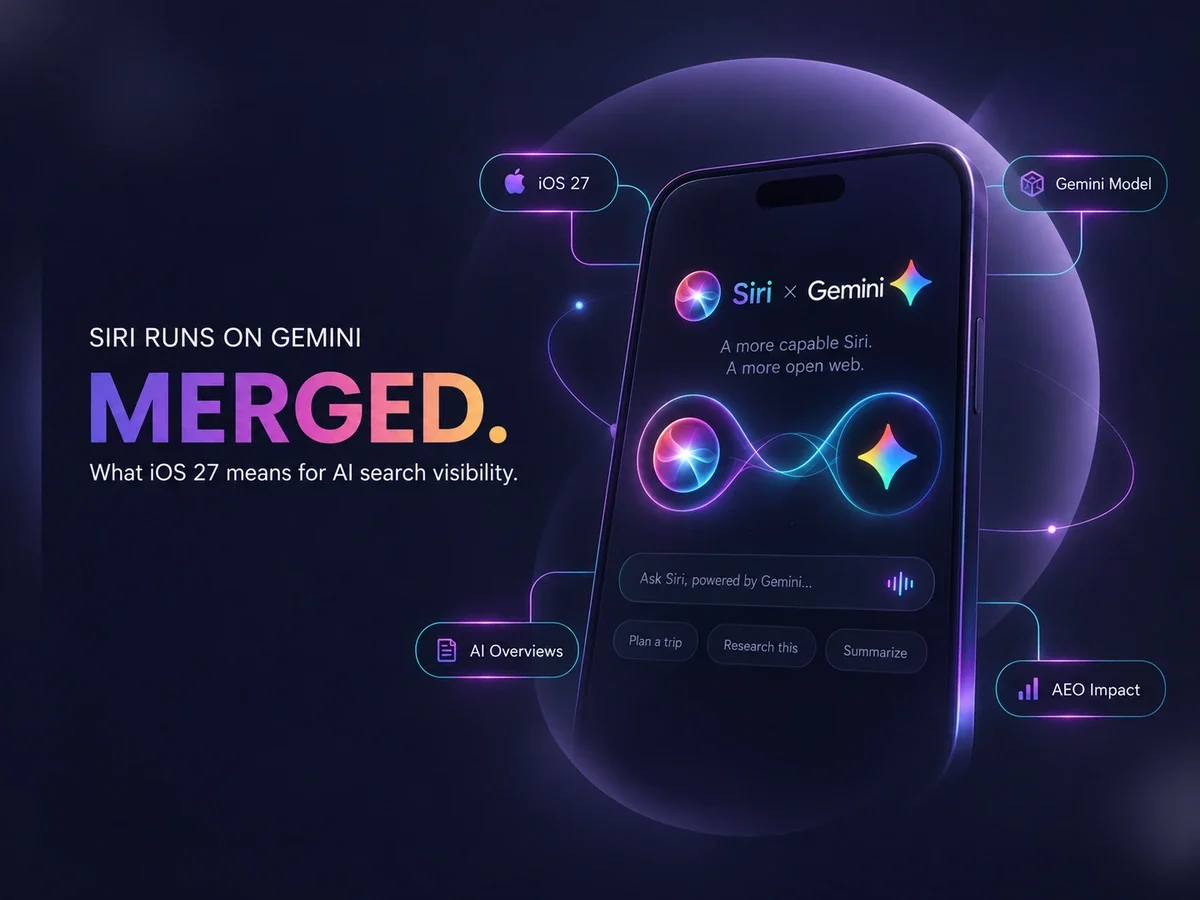
Quick answer: Apple shipped iOS 27 on September 14, 2026, with a rebuilt Siri that runs on Google’s Gemini. Google’s tech helps build Apple’s own models, and it powers the harder Siri questions through Google Cloud. For AEO, the real story isn’t Siri itself. It’s that Gemini, the same model behind Google’s AI Overviews, is now on hundreds of millions more phones.
Apple released iOS 27 on Monday, September 14, 2026. It comes with a rebuilt Siri called Siri AI, in beta, for iPhone 15 Pro and newer. You have to turn it on yourself in Settings, and some people land on a waitlist first. It can hold a conversation for more than 20 back-and-forth exchanges, read what’s on your screen, and act across Messages, Mail, Notes, and Calendar.
Apple confirmed its Google deal back in January 2026. Reports put the cost at around $1 billion a year. CNBC reported that Apple uses Gemini to help build its own on-device models, and that Apple’s Private Cloud Compute, used for harder Siri questions, runs on Google Cloud. Apple says none of that data gets stored or seen by Google. Siri AI is English-only for now. French, Japanese, Korean, Portuguese, and Spanish are coming next month, and it’s not launching yet in the EU or China for regulatory reasons. This follows a public beta TechCrunch covered back in July, when Apple first let more testers in.
Here’s the part that actually matters for AEO. Siri AI runs on Gemini. That’s the same model family behind Google’s AI Overviews and the Gemini app, the ones we’ve already covered in our guide to AEO and our guide to GEO tools and agencies. Apple didn’t build a new model with its own view of the web. It built a second doorway into a model your content might already be reaching, or already missing.
That cuts both ways. If Gemini already cites your site through Google’s own products, you’re not starting from zero on Siri. You didn’t do anything Siri-specific, you’re just already feeding the model Apple licensed. But if Gemini ignores your site today, it was already missing one major surface. Now it’s likely missing a second one too, on every phone that updates, without you changing a thing.
We wrote recently about Cloudflare’s new default rules for AI crawlers, which decide whether Google’s crawler can even reach your page at all. That question still comes first. If your site blocks the crawlers Gemini trains on, you’re not just missing Google’s AI surfaces. You may now be missing Apple’s too.
Nothing in the reporting so far says whether Siri AI shows clickable links or credits a specific website, the way AI Overviews or Perplexity do. That’s a real gap. We’d rather say so plainly than assume Siri works like the AI search tools we usually cover.
If Siri AI turns out to be a closed conversation with no visible sources and no click-through, its value for AEO is mostly indirect. It’s a new place Gemini’s knowledge gets used, not a new place your brand or link can show up. If Apple adds visible sourcing later, especially once Siri AI reaches more languages and more countries, that would be worth tracking on its own. Right now, we don’t know which way this goes. Nobody outside Apple does.
Web25 is our agency, and figuring out which AI surfaces actually matter for a business is part of the AEO/GEO work we do. Want a read on where your site stands with the AI tools that do cite sources today? Book a discovery call.
Don’t treat Siri AI as a separate thing to optimize for, at least not yet. There’s no known way to influence what Siri says about your brand that’s different from influencing what Gemini already says, since they run on the same model. The move that already works for Gemini and AI Overviews still applies here: write specific, well-sourced, crawlable content. We cover that in more detail in why AI isn’t citing a given page.
Keep an eye on two things: whether Apple adds visible sources to Siri AI as it expands, and whether that code evidence about Claude and ChatGPT turns into a real feature. If it does, “AEO for Siri” could mean tracking three different models inside one assistant instead of one.
Web25 tracks which AI surfaces are actually worth your attention, instead of treating every new AI product as something you need to chase. See our AEO/GEO/SEO service for how we approach it.
Nobody’s confirmed it either way yet, in any of the reporting on this launch. If it turns out Siri doesn’t, its role in AEO stays mostly indirect: a new place Gemini’s knowledge shows up in a conversation, not a new place your link or brand name can actually appear to a user.
Not right now. Siri AI runs on the same Gemini family behind Google’s AI Overviews, so whatever already helps your content get cited by Gemini helps here too. There’s no separate, Siri-specific lever to pull yet, and nobody outside Apple can say for sure if one exists.
iPhone 15 Pro and newer, in beta, opt-in only through Settings, with some people landing on a waitlist first. It’s English-only at launch. French, Japanese, Korean, Portuguese, and Spanish are expected next month, and it’s not available yet in the EU or China for regulatory reasons.
Code found around the iOS 27 launch suggests Apple built Siri to support Claude and ChatGPT too, going further than the Extensions framework Apple announced at WWDC. That’s not a confirmed, shipped feature yet, just code evidence, so treat it as a signal to watch rather than something live today.
Keep doing the specific, well-sourced content work that already helps with Gemini and Google AI Overviews. Siri AI runs on the same model for now, so that work already covers it. Want a full read on where your site stands with the AI tools that do cite sources today? Book a discovery call.
Written by Adam Khaled, Founder, Web25. Last updated September 2026.
Cloudflare now blocks AI training and agent crawlers by default on ad-carrying pages. Here’s what changed today, and what to check on your own site.
What full-service website management actually includes, what it costs versus a maintenance-only plan, and how to tell whether your business needs it.
AI tools don’t all work the same way. Here’s what the research actually shows about why some pages get cited by AI systems and others get skipped entirely.