AEO & GEO
What Is GEO in Marketing? A Plain-English Guide
14 min read

Adam Khaled
Founder, Web25
Adam Khaled
Founder, Web25
Quick answer: What is GEO in marketing? It usually means generative engine optimization: making your brand easy for AI tools like ChatGPT, Perplexity and Google’s AI Overviews to find, trust and mention in their answers. In older ad and local marketing, GEO can also mean geotargeting, which is showing ads to people in a chosen place. The context tells you which one someone means.
If someone in a meeting says “we need a GEO strategy”, you may not be sure which GEO they mean. That is a fair question. The same three letters describe two very different things in marketing, and the newer meaning has spread fast since AI tools started answering customer questions directly. This guide explains both in plain English, shows how to tell them apart, and gives you a practical way to start.
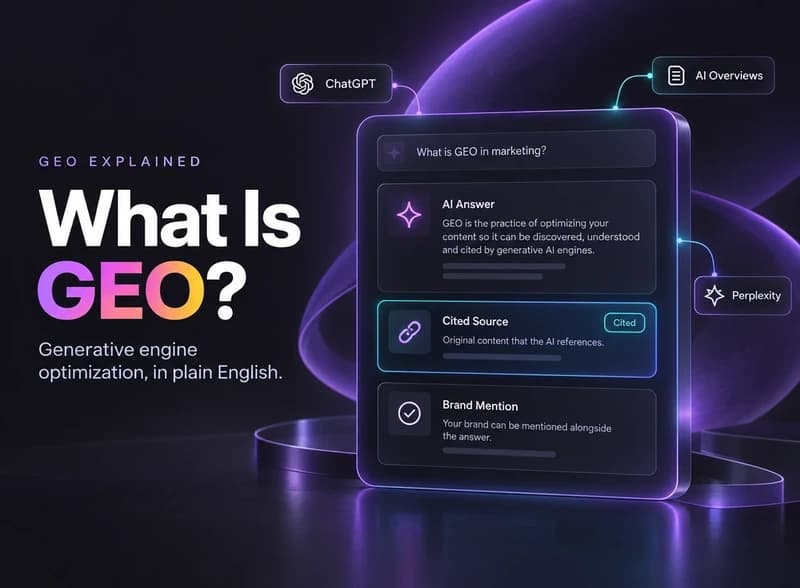
So, what is GEO in marketing? In most conversations about search and content today, GEO stands for generative engine optimization. It is the work of making your business easy for AI tools to find, understand and mention when people ask them questions. Those tools include ChatGPT, Perplexity, Microsoft Copilot and the AI Overviews at the top of Google.
The older meaning is geotargeting, sometimes called geo marketing. That is the practice of showing ads or offers to people in a specific location, such as a city, a region or a set distance around your shop. You will still hear “geo” used this way in paid ads and local marketing teams.
Both meanings are about reaching the right people. One does it by appearing in AI answers. The other does it by choosing where your ads show. The rest of this guide covers each one, starting with the meaning most people are searching for now.
The term generative engine optimization was introduced in a research paper by Pranjal Aggarwal and colleagues, first published in November 2023 and later accepted to the KDD 2024 conference. The authors described AI tools that collect information from many websites and summarize it into one answer. They called these tools generative engines.
Their concern was simple. When an AI writes the answer, website owners have little control over whether their content is used or how it is shown. The paper proposed GEO as a way for content creators to improve their visibility inside those answers, and it reported that some changes could raise visibility by up to 40 percent in their tests. It also found that what works differs from one subject area to another.
In practice, GEO asks a different question from classic SEO. SEO asks, “Does my page rank for this search?” GEO asks, “When someone asks an AI about this topic, is my brand named, and is my page cited as a source?” A page can rank well and still be left out of the AI answer, and the opposite can happen too.
That is why marketers now treat AI answers as a channel in their own right. Customers ask an assistant which accountant to use, which software fits a small team, or how to fix a problem, and they often act on the first answer they read. Being part of that answer is the goal of generative engine optimization.
Before AI answers existed, “geo” in marketing almost always meant location. Ad platforms let you choose where your ads appear. In Google Ads, for example, location targeting lets your ads appear in the places you select, such as countries, areas within a country, or a radius around a location. Google says the radius has to be at least one kilometre.
A plumber in Bratislava does not want to pay for clicks from another country, so they target the city and nearby towns. A shop with three branches might show different offers around each one. That is geotargeting, and it remains a basic skill for anyone running paid ads.
Geotargeting is not going away. It simply shares an abbreviation with a newer idea. If your team runs local ads, you will keep using the word in this sense, and that is fine as long as everyone knows which meaning is on the table.
Context almost always settles it. Look at the words around the term. If people talk about ChatGPT, AI Overviews, citations, answer engines or being mentioned by AI, they mean generative engine optimization. If they talk about ad campaigns, radius, cities, regions or local offers, they mean geotargeting.
When the context is unclear, ask. A short question like “do you mean AI search or location targeting?” saves a meeting full of crossed wires. It is also worth agreeing on one meaning inside your team and writing it into your briefs, so a request for “GEO work” lands with the right person.
The rest of this article uses GEO in its newer sense, generative engine optimization, because that is the answer most people want when they search what is GEO in marketing in 2026.
GEO is not a separate department. It sits on top of the work you already do. Your website, your content, your reviews and how other sites talk about you are the raw material AI tools read. GEO is the habit of shaping that material so an AI can understand it and trust it.
Three related terms often come up together, and the differences are small but useful. SEO is about ranking pages in search results. Answer engine optimization, or AEO, focuses on giving short, direct answers that can be lifted into featured snippets and voice answers. GEO focuses on being mentioned and cited inside full AI answers. Our guides on GEO vs SEO and AEO vs GEO compare them in more detail.
For most businesses the order of work is the same. First, get the SEO basics right so your pages can be found at all. Then make your key pages answer real questions clearly. Then build the outside signals, such as reviews, mentions and listings, that make an AI confident enough to name you.
Google has been clear on one point. On its guide to AI features, it says the best practices for SEO remain relevant for AI Overviews and AI Mode, and that there are no additional requirements to appear in them, nor other special optimizations necessary.
That matters because it cuts through a lot of hype. Nobody can sell you a secret switch that puts you inside Google’s AI answers. What Google rewards there is what it rewards in normal search: helpful, reliable pages that answer the question well.
Other AI tools work differently from Google and from each other, and none of them publish a full rulebook. So GEO is less about tricks and more about being the clearest, most trustworthy source on the topics you want to be known for.
You do not need a big budget to start. Most of the first steps are clean-up work on pages you already have.
Structured data helps too. Marking up your FAQs, articles and business details makes it easier for machines to read the page correctly, although it does not guarantee a mention on its own.
Then give it time. AI tools refresh what they know at different speeds, so changes can take weeks to show up in their answers. Treat GEO as steady maintenance, not a one-off project.
Measuring GEO is still rough, and it is honest to say so. AI answers change from one run to the next, so a single check tells you very little. The useful habit is to repeat the same questions on a schedule and count how often your brand is mentioned.
Start with the 10 to 15 customer questions from your list. Run each one several times in ChatGPT, Perplexity and Google, and record whether you are named, whether your page is cited, and which competitors appear. Do it again every month and watch the trend rather than any single result.
Google Analytics 4 can also show visits that arrive from AI assistants, and Search Console shows how your pages perform in Google. Our guide to AI search tracking walks through three free ways to set this up.
“GEO replaces SEO.” It does not. AI tools lean on the same pages search engines index, and Google says its SEO best practices still apply. Dropping SEO to chase AI answers usually hurts both.
“You can buy your way into AI answers.” You cannot pay ChatGPT or Google to be cited in an organic AI answer. Anyone promising guaranteed placement is selling something they do not control.
“Only big brands get mentioned.” AI answers often cite specific, well-explained pages from smaller sites, because they match the question closely. Clear beats big more often than you might think.
“GEO is a one-time fix.” AI tools, competitors and your own services keep changing. The businesses that stay visible are the ones that check and update their key pages regularly.
Web25 builds and maintains websites and helps businesses get found in both search and AI answers. If you want help, we start with the basics in this guide: clear pages, direct answers, consistent business details and a simple monthly check of how often AI tools mention you. If you are weighing outside help, our guide to choosing a GEO agency explains what to look for, and our overview of GEO tools and agencies covers the wider market.
In most marketing conversations today, GEO means generative engine optimization. It is the work of making your brand easy for AI tools like ChatGPT, Perplexity and Google’s AI Overviews to find, understand and mention. In older ad and local marketing, GEO can also mean geotargeting, which is showing ads to people in a chosen location.
No, but they overlap a lot. SEO aims for a ranked link in search results. GEO aims for a mention or citation inside an AI answer. Google says the usual SEO best practices still apply to its AI features, so good SEO is the base that GEO builds on.
The term generative engine optimization comes from a research paper by Pranjal Aggarwal and colleagues, first published in November 2023 and accepted to the KDD 2024 conference. The paper defined GEO as a way for content creators to improve their visibility in AI generated answers.
Yes, and often better than you would expect, because AI answers cite specific, clear sources rather than only the biggest brands. A small business with a clear service page, real reviews and plain answers to customer questions can be cited next to much larger companies.
Write down 10 to 15 questions your customers really ask, run each one in ChatGPT, Perplexity and Google several times, and note how often your brand is named. Repeat it every month. Paid tools only make sense once the list of questions gets too long to check by hand.
Usually not. Geo marketing, sometimes written geomarketing, means using location data to reach people in a place, for example local ads or store offers. GEO in capital letters, in a conversation about AI or search, almost always means generative engine optimization.
Write down five questions your customers ask most often and run them in ChatGPT and Google today. Note whether your business appears. That five-minute check tells you more about your GEO starting point than any report, and if you would like a second opinion, book a discovery call.
Written by Adam Khaled, Founder, Web25. Last updated October 2026.
Webflow vs WordPress in plain English: hosting, cost, design, SEO, maintenance and plugins compared, plus a simple way to decide which fits your business.
Content pruning case study: we removed 103 pages from LiveAgent and impressions rose. What we did, what Google says, and what is unproven.
Hiring a GEO agency? See what they do, the price ranges vendors publish, the red flags to avoid, and the questions to ask before you sign.