AEO & GEO
Slovakia e-invoicing 2027: what it is and how it works
13 min read

Adam Khaled
Founder, Web25
Adam Khaled
Founder, Web25
Last checked: 20 November 2026
I run Web25 in Bratislava. We build websites, online shops and POHODA connections for e-invoicing. This page explains the Slovak e-invoice (eFaktúra, also typed efaktura) and whether it applies to you.
Three numbers come up: IČO is your company ID, DIČ your tax ID and IČ DPH your VAT ID.
The facts come from official sources: the Financial Administration (Finančná správa), the Ministry of Finance, the law text, the European Commission and OpenPeppol. The examples and the parts about Web25 are my own. Where I could not confirm something, I say so.
Short version (as of 20 November 2026)
From 1 January 2027, a VAT payer in Slovakia must issue e-invoices for most sales to other Slovak businesses and public bodies, normally sent through a certified digital postman. VAT-exempt sales, for example, are left out. Every Slovak business must be ready to receive e-invoices, VAT payer or not.
| When | What happens |
|---|---|
| 1 January to 31 December 2026 | Voluntary year. |
| 1 January 2027 | The duty starts for invoices between Slovak businesses and public bodies. |
| 1 January 2027 to 30 June 2030 | The VAT control statement (kontrolný výkaz, the invoice list VAT payers file) stays. |
| 1 July 2030 | E-invoicing starts for certain sales to businesses in other EU countries. The control statement and the EC sales list (súhrnný výkaz, the report on EU sales) are abolished. |
If you are a VAT payer and sell to another business or public body in Slovakia, you must issue e-invoices for most of those sales. If you are not a VAT payer, you do not have to issue them, but you must be ready to receive them. This includes buyers without an IČ DPH. Sales to consumers are left out. If you sell to both businesses and consumers, the business invoices fall under the new rules and the consumer sales do not.
You have 15 days to issue the e-invoice, counted from the day of the sale or of an advance payment. You do not need your customer’s consent.
What if your customer is not ready? The Financial Administration manual (26 August 2026) says a supplier who sent correctly has met the duty. It also says the responsibility sits with the buyer, who may be sanctioned under the tax law.
It depends on how you are set up in Slovakia.
For your own case, call the Financial Administration help line: 048/43 17 222, option 7, working days 8.00 to 16.00.
No. An e-invoice is a file that the receiving program can read and process on its own, built to one European standard. A plain PDF is made for people to read, not for programs. The Financial Administration says the same. A VAT payer keeps each e-invoice for 10 years from the end of the year it relates to.
A digital postman (digitálny poštár, officially a certified delivery service provider) sends your invoices and receives the ones addressed to you. It can be part of the program you already use, and some are free. On 19 November 2026 the Financial Administration had approved 102.
Each postman is certified by OpenPeppol, the organisation behind Peppol, and approved by the Financial Administration. For receiving, you can have only one postman per tax ID (DIČ).
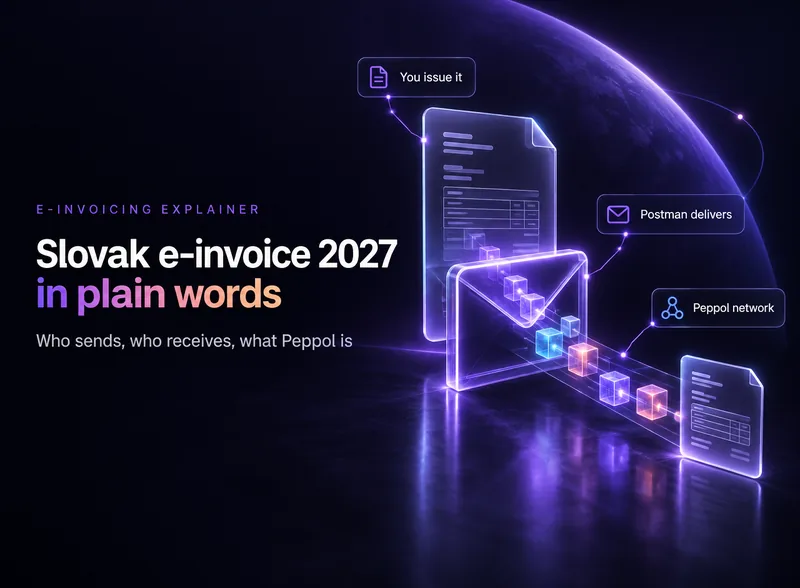
Peppol is a European network that carries business documents, such as invoices, between programs. Your postman takes your invoice and hands it to your customer’s postman, who delivers it.
Your address in the network is your Peppol ID. The Financial Administration says it is built from your DIČ. Your postman registers it for you once you have picked the postman in the Financial Administration app and signed the contract.
How an invoice travels:
You and your customer choose your postmen independently. Your invoice does not pass through one central post office, but a shared address registry tells your postman where to find the other one.
As the law reads today, your postman reports for you. The law counts your report as done when you hand the e-invoice to your postman, and the postman passes the data on to the Financial Administration.
The fines are tied to that reporting, so they do not concern you if you are not a VAT payer. They are up to 10,000 euros, and up to 100,000 euros for repeated breaches (VAT Act, as of 20 November 2026, details in Sources). They apply to not reporting, reporting late, or reporting incomplete or wrong data. There is no fine for an obvious mistake that you correct, or when a proven technical fault at your postman caused the delay and the data was reported right after the fault was fixed.
Not issuing an e-invoice is separate. The manual calls it a breach of a non-monetary nature under the tax law. The manual does not give an amount for it, or for the sanction on a buyer, and I could not find confirmed information from a trusted source about which amount would apply.
The law valid from 1 January 2027 contains no quiet period without fines, and neither does the official FAQ (November 2026). That FAQ also says an amendment of the VAT Act is still in parliament. Check the Financial Administration eFaktúra page before you act, because the final wording depends on parliament.
The official sources I read name three reasons: EU law, fighting VAT fraud, and less retyping. I could not read the explanatory report to the law, so these come from the Financial Administration, the Ministry of Finance and the European Commission.
EU law. The Financial Administration says the main aim of the amendment is to turn the EU directive of 11 March 2025 (“VAT in the Digital Age”) into Slovak law. The European Commission says that since these EU rules came into force, member states can introduce mandatory e-invoicing under specific conditions, and that EU digital reporting for cross-border business, based on e-invoicing, starts on 1 July 2030. The Financial Administration says the Slovak duty from 1 January 2027 for sales inside Slovakia comes from Article 1 of that directive.
Late data and VAT fraud. The Financial Administration says it learns about risky deals only after the VAT return and the control statement. With e-invoices the data will be available “practically in real time”. The Ministry of Finance review of September 2025 says part of the tax gap arises because the data needed to uncover fraud arrives with a delay. The Ministry says its action plan against tax evasion (November 2024) led to the amendment.
The VAT gap is the difference between the VAT that would come in if everyone paid correctly and the VAT that actually came in. For Slovakia in 2023 the European Commission estimated it at 1,087 million euros, or 10.5 percent (EU average about 9.5 percent, report of 11 December 2025). The Financial Administration says estimates speak of up to 300 million euros a year that the state could gain from better control and access to data (18 March 2026). It does not say whose estimates these are or how they were made. The same Ministry of Finance review adds a caution: mandatory e-invoicing alone may not raise VAT collection much.
Less retyping. The Financial Administration says some mismatches it finds today come from typos.
Web25 is not a postman, and we do not take a commission from any provider. We built a WooCommerce and POHODA connection for Mirael3D, live since 30 August 2026.
From 1 January 2027 you do not have to issue e-invoices, but you must be ready to receive them. Check your DIČ, create the portal account and pick a postman. Some are free (19 November 2026).
Ordinary citizens buying for private use are not affected, according to the Financial Administration (13 November 2026). As a business you still need to be ready to receive.
From 1 January 2027, not for most business invoices of a VAT payer, which must be e-invoices. Another way of sending needs the buyer’s consent and cannot be a plain PDF. The Financial Administration then gets no data automatically.
The fines are tied to the reporting duty: up to 10,000 euros, and up to 100,000 euros for repeated breaches. For not issuing, see the fines section above.
You met your duty if you sent correctly through a certified postman. The buyer may be sanctioned under the tax law. Ask your main customers which postman they use.
Ask your accountant first. The Financial Administration suggests agreeing with them who will issue, send, receive and check your invoices.
Web25 connects your online shop, invoicing program or other system with POHODA and the postman you choose. We reply by email. See how Web25 sets this up.
All read on 20 November 2026. Re-check scheduled for 30 November 2026. External links open in a new tab.
1. Financial Administration, eFaktúra hub. https://www.financnasprava.sk/sk/podnikatelia/dane/dan-z-pridanej-hodnoty/e-faktura (checked 20 November 2026)
2. Finančné riaditeľstvo SR (Financial Directorate of the Slovak Republic), “Najčastejšie otázky a odpovede k eFaktúre” (FAQ on e-invoicing), 9/DPH/2025/IM, 76 pages, version posted 20 November 2026 (same file as the 19 November version, not legally binding). https://www.financnasprava.sk/_img/pfsedit/Dokumenty_PFS/Zverejnovanie_dok/Aktualne/DPH/2026/2026.11.20_009_DPH_2026_IM_FAQ_eFakt.pdf (checked 20 November 2026)
3. Finančné riaditeľstvo SR, “Informácia k novele zákona č. 385/2025” (information on the amendment, Act 385/2025), 1/DPH/2026/I, 14 January 2026. https://www.financnasprava.sk/_img/pfsedit/Dokumenty_PFS/Zverejnovanie_dok/Dane/Novinky_leg/Nepriame_dane/2026/2026.01.14_001_DPH_2026_I.pdf (checked 20 November 2026)
4. Finančná správa (Financial Administration), manual “Povinná elektronická fakturácia pre firmy, živnostníkov a ďalšie podnikateľské subjekty od 1. 1. 2027”, 26 August 2026. https://www.financnasprava.sk/_img/pfsedit/Dokumenty_PFS/Podnikatelia/Dan_z_pridanej_hodnoty/efaktura/2026/2026.08.26_manual_efakturacia.pdf (checked 20 November 2026)
5. Slov-Lex, VAT Act 222/2004, version valid from 1 January 2027 (§ 85o, the e-invoicing duty and the fines). https://static.slov-lex.sk/static/SK/ZZ/2004/222/20270101.print.html (checked 20 November 2026)
6. Slov-Lex, Act 385/2025. https://static.slov-lex.sk/static/SK/ZZ/2025/385/vyhlasene_znenie.print.html (checked 20 November 2026)
6a. Slov-Lex, Tax Procedure Code 563/2009, version valid from 1 January 2027 (the general rules on breaches of non-monetary duties, which the manual refers to). https://static.slov-lex.sk/static/SK/ZZ/2009/563/20270101.print.html (checked 20 November 2026)
7. Financial Administration, news of November 2026 (2, 11, 13 and 19 November). List: https://www.financnasprava.sk/sk/pre-media/novinky/_2026 (checked 20 November 2026). Also the press release of 23 October 2026 on what to agree with your accountant: https://www.financnasprava.sk/sk/pre-media/novinky/archiv-noviniek/detail-novinky/_efaktura-zjednodusi-ts/bc (checked 20 November 2026)
8. Financial Administration, list of certified digital postmen, 19 November 2026. https://www.financnasprava.sk/_img/pfsedit/Dokumenty_PFS/Podnikatelia/Dan_z_pridanej_hodnoty/efaktura/2026/2026.11.19_Certif_digi_post.pdf (checked 20 November 2026). Providers in approval, 20 November 2026: https://www.financnasprava.sk/_img/pfsedit/Dokumenty_PFS/Podnikatelia/Dan_z_pridanej_hodnoty/efaktura/2026/2026.11.20_zoznam_cert_akred.pdf
9. Financial Administration, leaflet “eFaktúra od 1. januára 2027”, 19 November 2026. https://www.financnasprava.sk/_img/pfsedit/Dokumenty_PFS/Podnikatelia/Dan_z_pridanej_hodnoty/efaktura/2026/2026.11.19_eFaktura_zakl_info.pdf (checked 20 November 2026)
10. Financial Administration, press release of 13 July 2026. https://www.financnasprava.sk/_img/pfsedit/Dokumenty_PFS/Pre_media/Tlacove_spravy/Rok_2026/2026.07.13_TS_dan_podvody.pdf (checked 20 November 2026)
11. Financial Administration, press release of 29 July 2026 (myths). https://www.financnasprava.sk/_img/pfsedit/Dokumenty_PFS/Pre_media/Tlacove_spravy/Rok_2026/2026.07.29_TS_Myty_eFak.pdf (checked 20 November 2026)
12. Financial Administration, news of 18 March 2026. https://www.financnasprava.sk/sk/pre-media/novinky/archiv-noviniek/detail-novinky/_efaktura-uhp-ts/bc (checked 20 November 2026)
13. Ministry of Finance of the Slovak Republic, press release updated 14 January 2026. https://www.mfsr.sk/sk/media/tlacove-spravy/dalsie-opatrenia-boji-proti-danovym-unikom.html (checked 20 November 2026)
14. Ministry of Finance, Value for Money review, September 2025. https://www.mfsr.sk/files/sk/financie/hodnota-za-peniaze/hodnotenia/informatizacia/hodnotenie_iinfrastruktura-efaktura.pdf (checked 20 November 2026)
15. European Commission, VAT in the Digital Age. https://taxation-customs.ec.europa.eu/taxation/vat/vat-digital-age-vida_en (checked 20 November 2026)
16. European Commission, VAT gap (report published 11 December 2025). https://taxation-customs.ec.europa.eu/taxation/vat/fight-against-vat-fraud/vat-gap_en (checked 20 November 2026)
17. OpenPeppol, Interoperability Framework. https://peppol.org/learn-more/peppol-interoperability-framework/ (checked 20 November 2026)
18. OpenPeppol, About. https://peppol.org/about/ (checked 20 November 2026)
19. OpenPeppol, Discovering Peppol, May 2024. https://peppol.org/wp-content/uploads/2024/06/eInvoicing-Discovering-Peppol-May-2024.pdf (checked 20 November 2026)
20. Financial Administration, app for choosing a postman (linked in the news of 2 and 19 November 2026). https://vpds.financnasprava.sk (checked 20 November 2026)
Odoo Shopify integration in 7 steps: check your Odoo plan and hosting, pick an Odoo module, a Shopify app or custom code, and sync stock across locations.
QuickBooks Shopify integration in 7 steps: pick the right QuickBooks, choose an app or custom code, and make each Shopify payout match your bank deposit.
ERP website integration explained: what your website can pull from or send to your ERP, five ways to connect them, and 6 steps to scope the job.